Category: Inquiry

Inquiry Project Final

Hi everyone, Phoebe and I finished our inquiry today and did a whiteboard animation/presentation video podcast using Canva premium. We both hope you enjoy watching as we reflect on our inquiry process and dive into answering our main inquiry question: How does online technology play a role with self diagnosing? 

We experienced a few issues with making the white board animation as it was a new concept to both of us. We watched different tutorial videos on YouTube and ironically Tik Tok to help guide us, which furthermore highlights that technology and social media platforms has some cons but definitely has its pros as well.

Overall, this was a very enjoyable process and every bump in the road taught us new skills and the ability to find solutions to our problems.

References:

American Psychological Association. (n.d.). Health anxiety. Anxiety and Depression Association of America.

Banner Health. (n.d.). TikTok self-diagnoses on the rise: Why it’s harmful.

Columbia University. (n.d.). Understanding algorithms

Harvard University. (2025, April 2). Dr. TikTok: The impacts of misinformation on mental health self-diagnosis.

Johns Hopkins Medicine. (2023). Social media and self-diagnosis.

Mathes, B. M., Norr, A. M., Allan, N. P., Albanese, B. J., & Schmidt, N. B. (2018). Cyberchondria: Overlap with health anxiety and unique relations with impairment, quality of life, and service utilization. Psychiatry Research, 261, 204–211. 

Mood & Mind Centre. (n.d.). Self-diagnosing through TikTok

National Center for Biotechnology Information. (2020). Digital health literacy and its implications.

National Center for Biotechnology Information. (2022). ADHD-related content on TikTok

National Center for Biotechnology Information. (2023). Digital divide and health literacy.

National Center for Biotechnology Information. (2023). Artificial intelligence in healthcare.

National Center for Biotechnology Information. (2025). Future of AI in healthcare systems.

PubMed. (2018). Cyberchondria

PubMed. (2015). Effects of online health information

Saghafian, S. (n.d.). The analytics behind ChatGPT: Human, algorithm, or centaur?. Harvard University.

Stanford Institute for Human-Centred AI. (n.d.). Social media algorithms and mental health.

University of Chicago. (n.d.). Health information on TikTok

University of Colorado Denver. (n.d.). Down the rabbit hole of self-diagnosis in mental health.

University Health. (n.d.). The pros and cons of self-diagnosing online.

Waterloo University. (n.d.). AI’s medical diagnostic skills still need checking.

Process Update 4

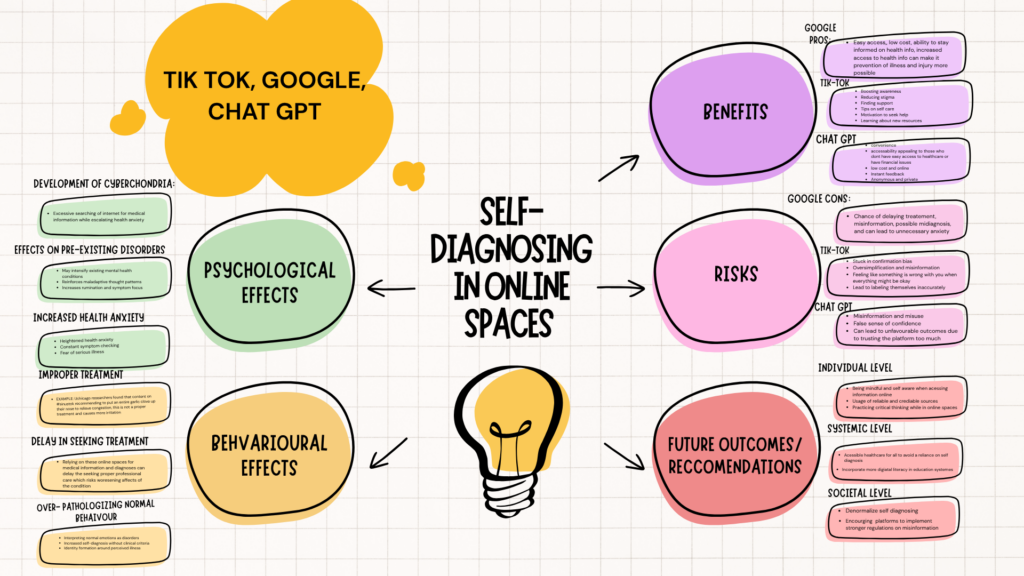
For this week’s task, step 4, Phoebe and I created a mind map using Canva. This was a very enjoyable process as it allowed us to dig deeper on the unanswered questions we had in a creative way.

Mind Map Sources

Benefits and Risks:

Chat GPT

Tik Tok

Tik Tok

Google

Psychological Effects:

Cyberchondria: “repeated Internet searches regarding medical information result in excessive concerns about physical health.”

Effects on preexisting disorders 

Preexisting disorders

Health Anxiety

Behavioural Effects:

Delay in seeking treatment

Improper treatment

Over-pathologizing normal behaviour 

Step 5

For step 5, we will be creating a whiteboard animation presentation to show what we have learned. The whiteboard animation will be our summary resource to show our learning.

Making a whiteboard animation on Canva premium is something new to us. We hope to develop new skills in regards to video making and editing. We will be making sure to include the principles of multimedia learning since we will be having different visuals and a voice over.

Our goal for this step is to combine all the information we have learned over the last few steps, reflect, and answer our question from step 1 on self diagnosing.

Over the next two weeks we will be completing these tasks:

Week 1:

Week 2:

  • Decide what will be said and drawn in each scene
  • Build the presentation
  • Record VoiceOver
  • Sync audio and learn how to edit them together on Canva
  • Clean it up: add text highlights, transitions, trim awkward pauses or long scenes, etc
  • Post final video on blog

Process Update 3

For step 3 of our inquiry project, Phoebe and I have created a set of new questions based on our research in order to help us answer our question on self diagnosing and help us deepen our understanding. We will be using google scholar and the UVIC library database to find articles to help us answer the questions below over the next week.

  • Which platform is most likely to spread misinformation about mental health or medical conditions?
  • How do algorithms influence what symptoms or disorders users believe they have?
  • In what ways can online self diagnosis be helpful or empowering?
  • Can it encourage people to seek help sooner?
  • How can it lead to over diagnosis or unneccesary stress
  • Are certain groups more vulnerable
  • Should AI tools be responsible for preventing harmful self-diagnosis?
  • How might self diagnosis change as AI becomes more advanced?
  • Could they replace parts of traditional diagnosis?

For step 4 we are planning on making a mind map on Canva. For the mind map we will put our findings from step 3 into the categories below:

  • pros and cons of each platform and brief overview of what they are
  • what effects they have psychologically and behaviourally
  • Outcomes, benefits vs risks
  • Future outcomes like will AI replace traditional diagnosis…

Process Update 2

For step 2, I found two articles based on my group’s research question and took some bullet point notes of what I learned. And we also did a self reflection on each of the 3 platform’s while role playing as a user who is self diagnosing themselves based on certain symptoms. My symptoms were feeling anxious, lack of focus, overthinking, and constantly worrying over plans. We created a set of questions for each platform and three questions to help us reflect on all 3 platforms. Below is my self reflection:

TIK TOK

How easy was it to find videos related to the symptoms I searched?  

It was pretty easy, once I searched in my “symptoms” multiple videos showed up from many different users that were either experiencing the same symptoms or Doctors/Professionals discussing what those symptoms might be.

Did the algorithm start showing me similar videos after my initial search?

Yes, after I clicked on a few videos I noticed that the algorithm had added more health related videos into my feed.  

Were any of the videos I found made by actual credited doctors or just influencers/ random users talking about their personal diagnosis or symptoms?  

There was a mix, some doctors or nurses had posted videos related. There were videos educating on several diagnosis as well as users reporting same symptoms and looking for answers from other users.

CHATGPT

Did the conversational format make the information feel more trustworthy? 

When I put in my “symptoms” into Chat GPT, the first thing it responded with was ” Im sorry you are experiencing this…I can’t diagnose you but I can go over several possible causes…”

This made me feel almost like I was talking to a real person online and made the conversation more casual and less formal which made me feel like I could trust it. I had a feeling I cant really describe but the conversational format made me feel like that Chat GPT had my best interest in mind when responding in a way which was kind of weird knowing it is not a real person.

GOOGLE

Did I feel overwhelmed by the amount of information available? 

Yes, I did. There were more than 10 articles and blog posts I could scroll through that was related to my “symptoms”. Some were saying the same thing, some were going into more detail, and some were saying the complete opposite so it made me feel overwhelmed and I didn’t know which one I should “trust”.

Did the search results include critical medical sources or mostly general websites?

Yes, Most were credited sources like the National Institute of Mental Health, University of California, Mayo Clinic, and Harvard Health.

ALL 3

What was my first impression when trying to diagnose symptoms on each platform?

With Tik-Tok my first impression was being surprised that there were many other users experiencing similar symptoms, and how the Tik-Tok algorithm groups these videos together helping you find information. I also found the short videos to be less overwhelming. With Chat GPT my first impression was feeling overwhelmed because there were so many possible “diagnosis” it gave me when I put in my symptoms. With google, I felt less overwhelmed with my first impression but as I kept scrolling through I felt more and more overwhelmed with the amount of information.

Which platform gave me information the fastest?

Chat GPT gave me the information the fastest but it did not hyperlink any resources or where it was getting that information from like google does but in terms of speed, I’d say Chat.  

Which platform felt most convincing?

This is a hard question because I feel like Chat GPT’s conversational format felt convincing but also being able to see real life people on Tik-Tok, whether they were doctors or users, and hear what they had to say also felt really convincing. Thus, I think I’d have to go with Tik-Tok.

After completing step 2, we are now brainstorming new questions that will help us complete step 3 and support our overall inquiry.
Process Update 1

My partner, Phoebe and I are both psychology majors and decided to collaborate on this inquiry project together. The topic we decided online self diagnosing. It aligns with the digital wellbeing section in the BC Post Secondary Digital Literacy Framework. 

Step 1: How does online technology play a role with self diagnosing? 

We are planning on focusing on the social media platform Tik-Tok, the AI platform ChatGPT, the search engine google as the online tools users might use to self diagnose. 

We will be using google scholarPubMed, and Uvic psychology database to help us with finding research articles. 

We are also planning on starting to cover these topics in order to start our inquiry process: 

  • brief overview of what topic is, what the platforms are 
  • pros and cons to each platform 

To show our inquiry findings we will be exploring and utilizing Canva Premium to make a whiteboard animation at the end of our inquiry project

© 2026 EDCI Parmis

Theme by Anders NorenUp ↑