References:
Theories:
Research Studies:
References:
Theories:
Research Studies:
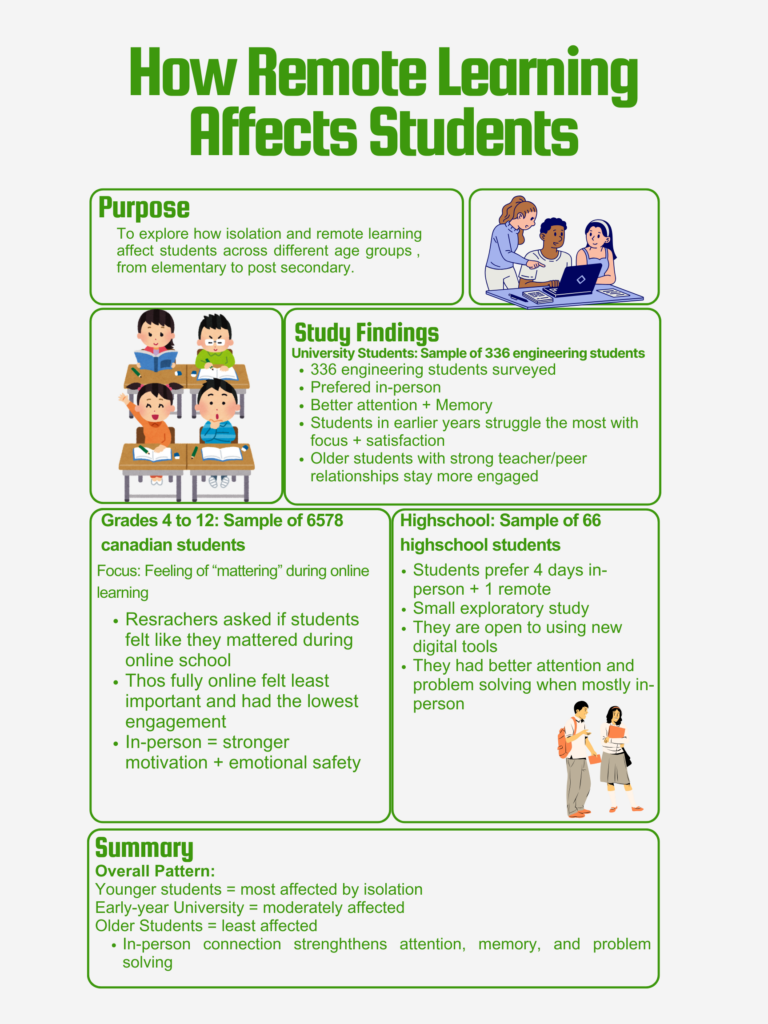
Here is my infographic which I made on Canva using these references:
Assignment 2 with Brooklyn, Vinayak, and Divyansh. In this group presentation, we dive into inquiry based learning and its role in fostering critical thinking skills in remote learning environments. Hope you enjoy watching!
References:
Slide 4: Initial thought and findings
Image made by me, on Canva, November, 29
I found this article I wanted to unpack because it talks about what it actually means to be apart of an online learning community. The researchers looked at 309 psychology undergrads enrolled at the University of Leeds. These students were pushed into emergency remote learning during COVID. The researchers asked them to write a hundred words on what “learning community” meant, give an example of when they had felt part of one, and what would improve that feeling. They used reflexive thematic analysis to let student’s own words lead the way. Thematic analysis is a way of analyzing qualitative data like interview transcripts, open-ended survey answers, or written reflections, by looking for patterns or themes across the answers. The analysis resulted in three key themes emerging:
What really stands out is that community, from the students perspective, wasn’t about fancy platforms or perfectly structured courses, it was about relationships, access, and visibility. Students talked about how isolating online learning felt because it lacked the face to face connection. They also mentioned that it’s hard to feel apart of a community when you’ve never met your classmates. They mentioned being able to go to the library and see other students working, going to lectures and seeing other students in person, and meeting fellow psychology students. All of these were strengths of in person learning. Some even mentioned how during online lectures most students kept their cameras off and conversations were one-way which furthermore affected their sense of community. The only interaction was content delivery. They wrote about feeling more like part of a community when they had regular, human contact with both peers and staff which is an improvement that could be made. This improvement could be having small group spaces to compare notes, group chats to share struggles, cameras on during interactions, and informal virtual meet ups that replicate spontaneous conversations that normally happen on campus. This could happen on discussion boards or peer support channels and can help reduce the feeling of being isolated as an online learner. The article also stressed the importance of visibility and support from staff beyond just delivering content. This could be through personalized communication, quick responses to concerns, and being invited into spaces typically reserved for academics (like research seminars) helped students feel valued and included.
The researchers and authors argue that if were going to keep using “learning community” in policy tools and surveys in higher education, particularly in online models, we need clearer definitions that reflect how students themselves understand community. And they understand it as connection, inclusion, mutual learning, and the option to engage on their own terms. This was a reminder to me and maybe others who are in online learning communities or trying to make one, that they don’t just “happen” on zoom. They have to be intentionally built around our needs as humans which is connection.

Image made by me, Parmis Banihashemi, using Canva, Nov. 2025
This article explores the rapid transition to full online learning during the COVID-19 pandemic and examines the different barriers faced by instructors, students, and institutions. The study described the big shift from in person to remote as “massive distance education” (MDE). They identify several different barriers. First-order barriers like lack of internet access, limited devices, and lack of training for teachers. Second order barriers which involve people’s beliefs and attitudes towards technology which includes parents not just students and teachers. Third order barriers are related to the difficulty of designing engaging and meaningful lessons. They also identify a “2.5 order barrier” which refers to teachers experiencing challenges with managing student behavior and engagement during remote learning.
Both teachers and students are facing challenges when it comes to having stable internet connection, some experience limited internet connectivity and it affects the students focus and learning online. Teachers are being required to suddenly use new classroom designs and parents need to support their kids during this shift to remote learning at home. One thing that came to my mind in regards to this matter, is impoverished communities where students might not have access to technology or stable internet at home and relied on in person schooling systems to offer resources like computers which this article also highlights. The study found that groups with better access to technology resources created a digital divide to those who do not and refers to them as videoconferencing refugees. The study also found that some students were feeling overwhelmed with the amount of time they had to spend on technology. In this day and age with parents who have put limits on their childs screen time, parents could now also be struggling to have to allow their kids to face a screen for many more hours a day than beforehand. The article states that online education is possible if all four barriers are dealt with.
This study also discusses how the quality of online learning was influenced by the choice of online platform and how well teachers could use different interactive tools to keep students engaged. Some teachers experimented with technology like virtual reality which I have never personally experienced but can imagine how engaging that would be. It shows how much creativity and adaptability is needed to make online learning effective. Even though not every classroom or online school has access to these advanced tools, this highlights the potential of different kinds of technology making remote learning more meaningful.
One benefit mentioned is how in person classes had limited space, whereas online learning allows an unlimited number of students that can attend class together. This was something I havent really reflected on before, the restrictions of physical classrooms. As a university student I feel like I have experienced not getting into a course a few times so I can relate to this point now. However, when I was in high school, I was less aware that limited space could be an issue for myself or others.
Overall, this article helped me see both the challenges and advantages of massive distance education. It showed me how technology can expand learning opportunities but also how important it is to design online education in a way that keeps students motivated and connected.
Update for Step 4:
I have been following the goals I have set and completing the learning activities I have created in order to address the questions I made in step 3. This past week, I spent time discussing with peers how remote learning impact student motivation across different subjects and socioeconomic backgrounds.
I asked them questions like during our discussion like:
Reflecting on my peer’s responses is helping me identify patterns in people’s experience with online courses and what factors influence motivation. My goal is to better understand the psychological side of these differences.
I have 2 activities/projects planned to help me address the questions in step 3. I will be making an infographic on the cognitive effects of learning in isolation. I will be looking for 2-3 case studies that compare remote vs. in person learning to help me see the differences between ages. For the second activity I plan on exploring three different online tools like bright space, zoom, and google classroom, for 15 minutes each and then writing a short journal reflection after each experience. I will then rank them from most to least effective for supporting motivation.
Update for Step 3:
I read through two PDFs and articles about Self Determination Theory and Cognitive Load Theory to understand how they define motivation and relate it to online learning. While doing this, I also started answering some of the guiding questions I developed, such as what cognitive effects occur when learning happen in isolation compared to collaborative settings, however I will be researching the other guiding questions more in step 4. I explored studies comparing different learning environments and noted key findings about how isolation can affect engagement and comprehension. Throughout this process I took detailed notes on my notion page which you can see under weeks 1-3. This helped me organize me ideas and evidence under each question and connect the theories to real world examples of remote learning.
Starting Step 4:
I’ve moved beyond forming new questions and am now focused on creating a plan to answer my questions from step 3. My goal for step 4 is to organize a focused plan on Notion with weekly due dates and activities that connect psychological concepts I have learned with real world evidence and examples.
To be able to connect it more with real life examples, I plan on asking some peers some questions and having a discussion about their remote learning experiences. I want to compare experiences. I also plan on reflecting on my own past experience being a remote learner in high school during COVID.
To stay organized, I will be using Notion as i’ve said in previous posts. Notion will help me stay on track with deadlines and research tasks each week. It has already been a helpful tool with step 1 and 2. I will be summarizing my findings and looking for patterns across age, socioeconomic background, and learning tools to see if there are any differences.

Image made by me, Parmis Banihashemi, Made on Canva, (October, 2025)
Connectivism is a new theory of learning that tries to explain how people learn and create knowledge in a world connected by technology. Connectivism isn’t focusing on how we learn as individuals, it’s more about how knowledge exists in networks, not just in our heads. Essentially, it argues that knowledge lives in connections, it’s not stored in one persons’ brain, but spread across many “nodes”. Different forms of nodes can be websites, organizations, databases, and people. Learning happens when you make new connections between these nodes. As cited in the textbook section 2.6, Siemens 2005 quote says “ the pipe is more important than the content of the pipe”, I thought this was such a clever way to put it, he is saying that knowing where and how to find information is more valuable than memorizing facts and content. The author also says that with connectivism, knowledge is chaotic and I agree, knowledge is meant to be chaotic as information flows in and “nodes” come and go.
The concept of connectivism reshapes how I think about online learning and where knowledge actually lives. According to Trembley (2025), a learning management system (LMS) is a software created to track and deliver online learning, education, and any form of online training. The instructor organizes materials, sets due dates, creates quizzes to assess online learning, and controls the flow of information. Traditional learning management systems (LMSs) such as what we use for our courses here at UVic (Brightspace), are usually built around a structured, top-down model of education. LMSs have more of a contstructivism approach where students have the opportunity to develop an understanding from the materials provided within a closed environment.
However, with connectivism, knowledge isn’t only within us as individuals or the institutions we attend, but within the networks of connections we create and this is how it can challenge LMSs. In today’s digital society, we can make meaningful learning connections when we are able to navigate and make sense of diverse sources of information which exist outside an LMSs. From my perspective as a student, a LMS like Brightspace for example, can be very limiting because it focuses on the tools and information given on that system instead of encouraging students to go beyond and explore the web of knowledge that exists outside of it.
A networked approach to online learning would mean using tools like social media or discussion forums to better reflect connectivism principles. As cited in the textbook, some principles include diverse learning, being able to see different opinions, and the ability to find, evaluate, and connect information across multiple contexts. Using this approach, makes learning less about memorizing static content or “the content of the pipe” as Siemens said, and more about building a dynamic personal network of ideas and tools. It supports lifelong learning and helps strengthen the ability to connect new information sources which is more valuable than any single piece of knowledge.
Reflecting on my own experience, I notice that when I engage with my peers through online communities, follow experts on social media platforms like Instagram and Tik Tok, and explore readings online, my understanding of the material deepens. When information is presented in different forms, it helps me, as a visual learner, understand the material better. These networked connections help me see relationships between concepts and apply them in real world contects which is exactly what Siemens and Downes describe in the textbook as the essence of connectivist learning. While the LMSs provide structure and organization, it’s the networked interactions that push me to think beyond the classroom and make my learning more personally meaningful.
Good online learning needs a balance between the structure of a LMS and the flexibility of a networked environment. Lms offers a very solid base, but connectivism shows that real learning happens when we go beyond it and connect with others while exploring new ideas.
For Step 1 I have chosen: The Psychology of Remote Learning: Does studying in isolation impact motivation and cognitive development?
I have created my Notion as a resource to help me stay on track with my personalized learning plan. Notion can help me with my plans on creating a survey for step 2.
This week my goals were step 2 and 3.
Step 2:
I started with defining motivation, exploring and understanding concepts like intrinsic vs extrinsic motivation. One of the main questions that I started with was:
What psychological theories explain motivation in remote learning?
For this question I have decided to research Self Determination Theory and Cognitive Load Theory.
I will also be creating a survey (on Notion) to send to family and friends to gather some evidence on how remote learning can affect motivation from real life examples. My survey will be 10 questions that can help me learn more on how remote learning affects people individually and compare answers. I have started brainstorming for the survey and will ask questions like:
Step 3:
My focus is more on refining my inquiry questions and narrowing my topic to make it more meaningful. For step 2 my inquiry started broadly but I realized I needed to focus a bit more on the motivation aspect of remote learning and what psychological factors influence this. In this stage, I have reviewed some of the notes I’ve made on different theories and the meaning of motivation to start and will be using the two main theories I mentioned above as a guide. These frameworks can help me see how motivation and learning are interconnected processes.
Based on this understanding, I created a list of more targeted questions to answer in step 4, including:
I’m using google scholar to find articles related to these topics and to help me answer the questions above. I am documenting my findings and notes on Notion.
I have started my learning plan using Notion to help me stay on task and document my progress.
My question for the inquiry topic will be: Does studying in isolation impact motivation and cognitive development?
I have created a guide to learning about this topic which can be seen on my Notion:

© 2026 EDCI Parmis
Theme by Anders Noren — Up ↑