References:
Theories:
Research Studies:
Assignment 1
References:
Theories:
Research Studies:
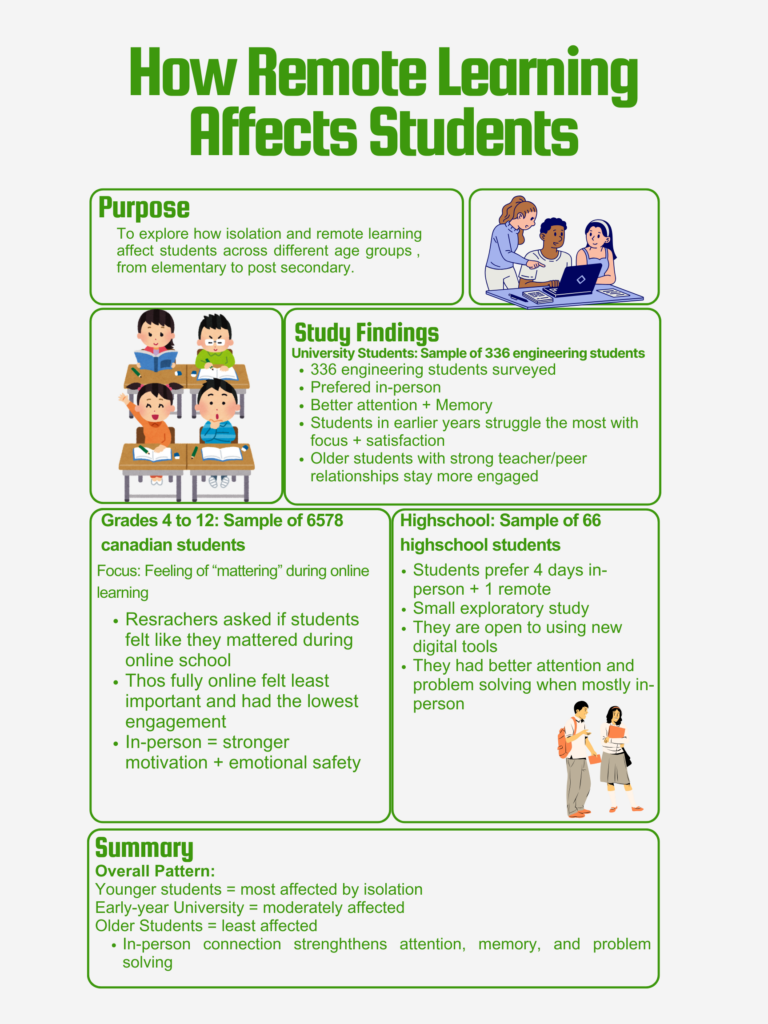
Here is my infographic which I made on Canva using these references:
Assignment 2 with Brooklyn, Vinayak, and Divyansh. In this group presentation, we dive into inquiry based learning and its role in fostering critical thinking skills in remote learning environments. Hope you enjoy watching!
References:
Slide 4: Initial thought and findings
Update for Step 4:
I have been following the goals I have set and completing the learning activities I have created in order to address the questions I made in step 3. This past week, I spent time discussing with peers how remote learning impact student motivation across different subjects and socioeconomic backgrounds.
I asked them questions like during our discussion like:
Reflecting on my peer’s responses is helping me identify patterns in people’s experience with online courses and what factors influence motivation. My goal is to better understand the psychological side of these differences.
I have 2 activities/projects planned to help me address the questions in step 3. I will be making an infographic on the cognitive effects of learning in isolation. I will be looking for 2-3 case studies that compare remote vs. in person learning to help me see the differences between ages. For the second activity I plan on exploring three different online tools like bright space, zoom, and google classroom, for 15 minutes each and then writing a short journal reflection after each experience. I will then rank them from most to least effective for supporting motivation.
Update for Step 3:
I read through two PDFs and articles about Self Determination Theory and Cognitive Load Theory to understand how they define motivation and relate it to online learning. While doing this, I also started answering some of the guiding questions I developed, such as what cognitive effects occur when learning happen in isolation compared to collaborative settings, however I will be researching the other guiding questions more in step 4. I explored studies comparing different learning environments and noted key findings about how isolation can affect engagement and comprehension. Throughout this process I took detailed notes on my notion page which you can see under weeks 1-3. This helped me organize me ideas and evidence under each question and connect the theories to real world examples of remote learning.
Starting Step 4:
I’ve moved beyond forming new questions and am now focused on creating a plan to answer my questions from step 3. My goal for step 4 is to organize a focused plan on Notion with weekly due dates and activities that connect psychological concepts I have learned with real world evidence and examples.
To be able to connect it more with real life examples, I plan on asking some peers some questions and having a discussion about their remote learning experiences. I want to compare experiences. I also plan on reflecting on my own past experience being a remote learner in high school during COVID.
To stay organized, I will be using Notion as i’ve said in previous posts. Notion will help me stay on track with deadlines and research tasks each week. It has already been a helpful tool with step 1 and 2. I will be summarizing my findings and looking for patterns across age, socioeconomic background, and learning tools to see if there are any differences.
For Step 1 I have chosen: The Psychology of Remote Learning: Does studying in isolation impact motivation and cognitive development?
I have created my Notion as a resource to help me stay on track with my personalized learning plan. Notion can help me with my plans on creating a survey for step 2.
This week my goals were step 2 and 3.
Step 2:
I started with defining motivation, exploring and understanding concepts like intrinsic vs extrinsic motivation. One of the main questions that I started with was:
What psychological theories explain motivation in remote learning?
For this question I have decided to research Self Determination Theory and Cognitive Load Theory.
I will also be creating a survey (on Notion) to send to family and friends to gather some evidence on how remote learning can affect motivation from real life examples. My survey will be 10 questions that can help me learn more on how remote learning affects people individually and compare answers. I have started brainstorming for the survey and will ask questions like:
Step 3:
My focus is more on refining my inquiry questions and narrowing my topic to make it more meaningful. For step 2 my inquiry started broadly but I realized I needed to focus a bit more on the motivation aspect of remote learning and what psychological factors influence this. In this stage, I have reviewed some of the notes I’ve made on different theories and the meaning of motivation to start and will be using the two main theories I mentioned above as a guide. These frameworks can help me see how motivation and learning are interconnected processes.
Based on this understanding, I created a list of more targeted questions to answer in step 4, including:
I’m using google scholar to find articles related to these topics and to help me answer the questions above. I am documenting my findings and notes on Notion.
For assignment 1, I have been taking a look at some of the open inquiry topics involving open and distributed learning and there were four that stood out to me:
I am a psychology major and am active on social media. I have also taken a few courses on how social media affects our development, society, and learning. Which is why these were the topics that immediately caught my eye. After groups have been formed for this assignment, I will brainstorm topics and mentions the ones I have stated above as potential options. In the meantime i’m going to do some research on all four topics before my group meets.
I have decided to use Notion to set my weekly goals with deadlines, make notes of different resources I plan to use, and document my progress and will be sharing this with my group. I will be posting weekly updates on WordPress as well on the group’s progress. For research I will be using Google Scholar, PubMed, and ResearchGate to find different studies.


© 2026 EDCI Parmis
Theme by Anders Noren — Up ↑